The One-Touch Rule for Household Clutter That Works in Real Homes
Stop moving clutter from one counter to another. Here is how to reduce surface friction once and for all.
Surface clutter isn't a symptom of personal laziness, it's usually just friction in your daily drop zones. When you walk through the door with mail, keys, bags, and groceries, you take the path of least resistance. If putting an item away takes three distinct movements, it lands on the kitchen counter instead, and it stays there until a separate, dedicated cleaning effort moves it again.
The one-touch rule for household clutter is a low-friction organization principle designed for real homes. The premise is simple: handle items once whenever possible, moving them directly to their final resting place rather than creating intermediate piles.
Why intermediate clutter piles form
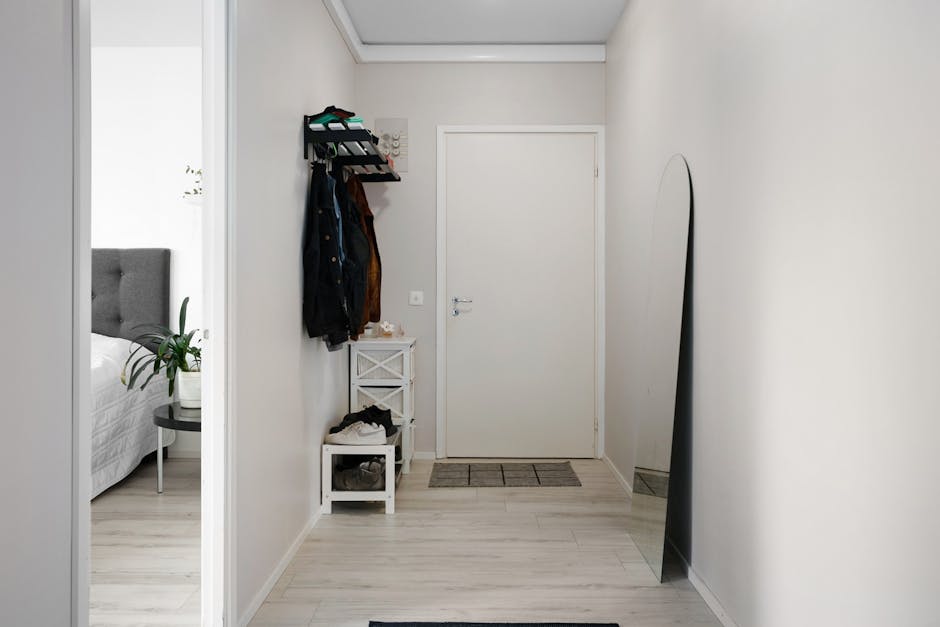 Photo by Alex Tyson via Pexels
Most household clutter consists of items waiting for a second step:
- Mail opened and left on the island to be filed later.
- Coats draped over dining chairs instead of hung in the hall closet.
- Clean laundry dumped on a bedroom chair waiting to be folded.
Each of these represents a deferred decision. When you defer decisions repeatedly throughout the week, visual noise accumulates, and the pile starts to feel heavier than any single deferred item really is.
Implementing one-touch habits in high-traffic zones
 Photo by Kindel Media via Pexels
1. The entryway and drop zone
Set up open storage rather than closed doors near your primary entrance. Baskets without lids, wall hooks instead of hanger closets, and key dishes eliminate micro-barriers to putting things away immediately, since every extra step (opening a door, finding a hanger) is a chance for the item to get set down instead.
2. Physical and digital mail
Process incoming mail directly over the recycling bin. Catalogs and circulars go straight into paper recycling; bills get scanned or placed into an active action tray immediately. Never set unopened mail on a living room surface, that single habit alone eliminates one of the most common sources of persistent counter clutter.
3. Dishes and kitchen counters
Load dirty dishes directly into the dishwasher after meals rather than letting them soak in the sink. If a pot needs scrubbing, clean it immediately while the water is still hot, since a pot left to "soak" frequently sits untouched for a full day or more.
What to do on chaotic days
 Photo by Ron Lach via Pexels
On days when energy is depleted, fall back on a single drop basket. Instead of scattering items across five counters, restrict all temporary items to one designated vessel. Clear that basket every evening during your ten-minute night sweep, so even a genuinely chaotic day doesn't compound into a chaotic week.
Setting up the physical spaces that make it easy
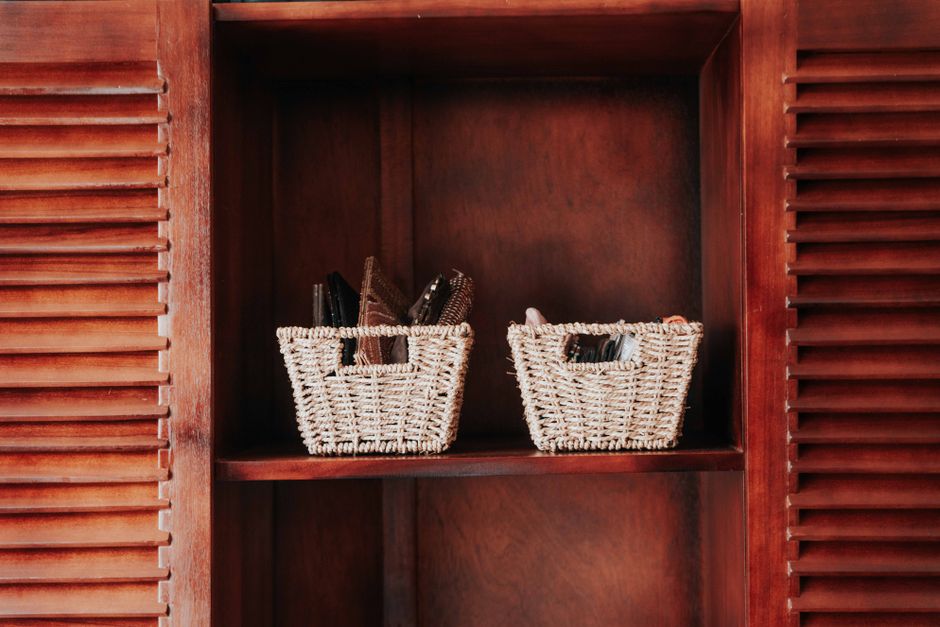 Photo by Keegan Checks via Pexels
The one-touch rule only works if the "final resting place" for common items is genuinely faster to reach than the counter. Walk through your own daily path from front door to kitchen and identify where you most often set things down, that's exactly where a hook, basket, or shelf needs to exist. A one-touch system fails less often because of willpower and more often because the designated spot was never actually convenient in the first place.
Extending the rule beyond the entryway
 Photo by khezez | خزاز via Pexels
The same logic applies throughout the house: hang a towel immediately after use instead of draping it over a chair, put shoes directly in a closet or rack rather than by the door, return a book to its shelf right after finishing instead of stacking it on a nightstand indefinitely. None of these individually matters much, but together they're the difference between a home that stays tidy with minimal effort and one that requires a dedicated weekly reset to undo a week of small deferrals.
Teaching kids the one-touch habit
 Photo by Kindel Media via Pexels
Kids can absorb the one-touch principle far more easily than a full cleaning routine, since it's a single, simple rule rather than a checklist: "when you're done, it goes back, not down." Low bins at kid height for toys, a designated hook at a reachable height for backpacks, and consistent, gentle reminders in the first few weeks build the habit faster than periodic toy-room resets.
Applying the rule to shoes specifically
Photo by Alex Tyson via Pexels
Shoes are one of the most common single sources of entryway clutter, largely because taking them off is often the very last thing that happens before a person is already distracted by whatever comes next, a ringing phone, a hungry kid, mail to check. A shoe rack or tray positioned exactly where shoes come off, not a step or two further into the house, removes the small gap between "shoes off" and "shoes away" where the one-touch rule most often breaks down in practice.
What a one-touch home feels like after a month
 Photo by Letícia Alvares via Pexels
The visible difference isn't a home that's spotless, it's a home where the "quick tidy before guests arrive" scramble largely disappears, because there was never much to tidy in the first place. Surfaces stay clear by default rather than through periodic effort, which is the actual goal: not a cleaner home on any single day, but one that requires dramatically less recurring effort to keep that way.
Applying the rule when you share a home with someone who doesn't
A one-touch system implemented by only one person in a shared household holds up better than nothing, but it's genuinely fragile, every item a partner or roommate sets down "for later" becomes a piece of clutter you didn't create and can't fully control. Rather than quietly picking up after someone else indefinitely, naming the specific friction point directly ("could bills go straight in the tray instead of the counter?") and adjusting the physical setup to make the easy path and the tidy path the same path tends to work better than repeated reminders alone.
Why this rule outperforms periodic deep cleans
A home maintained through daily one-touch habits requires a fundamentally smaller weekly or monthly deep-clean than one that relies on periodic resets to undo weeks of accumulated clutter. The one-touch rule doesn't eliminate the need for occasional deeper cleaning, vacuuming, dusting, scrubbing, but it does remove the layer of clutter that makes those sessions feel bigger, and more dreaded, than they need to be.
Restarting the habit after it slips
Even well-established one-touch habits slip during a stressful stretch, a big project at work, an illness, a vacation that disrupts the routine for a week or two. When the habit lapses and clutter starts creeping back, the fastest way back isn't a single marathon reset session, but simply returning to the one-touch rule starting with the next item you touch. The habit rebuilds itself item by item far more sustainably than trying to force an entire home back to zero in one sitting after a genuinely busy stretch.
A two-minute nightly check as a safety net
For households where the one-touch habit hasn't fully stuck yet, a two-minute walk-through before bed, checking the entryway, the kitchen counters, the living room, catches whatever slipped through during a busier-than-usual day. This isn't a substitute for the one-touch habit itself, but a safety net underneath it, useful especially in the first month or two while the habit is still forming and occasionally lapses under real-life pressure.
- Reduce the physical steps needed to put daily items away.
- Process mail directly over the recycling container, and load dishes straight into the dishwasher.
- Set up genuinely convenient "final resting places" (hooks, baskets, shelves) wherever you actually tend to set things down.
Frequently asked questions
What is the one-touch rule?
It means putting items directly in their final location rather than placing them on temporary surfaces.
What if I am too tired to put things away?
Use a single drop basket for temporary items and clear it in a 10-minute evening sweep.